Top Cities For Millennials Buying Homes: Where to Find Value in 2025
Millennials Are Buying Homes— Check out the top cities for millennials where affordability meets opportunity, and discover what makes these markets ideal for first-time homebuyers.
Table of Contents
Millennials Are Finally Buying Homes
After years of delays caused by student debt, rising home prices, and economic uncertainty, millennials are now the largest generation of homebuyers, representing 38% of all purchase transactions according to the National Association of Realtors. Born between 1981-1996 (ages 29-44 in 2025), millennials have reached their prime earning and family-formation years.
What Changed?
- Remote Work Revolution: With 32.6 million Americans working remotely, millennials can live anywhere—not just expensive coastal cities
- Student Loan Relief: Income-driven repayment plans and forgiveness programs freed up cash flow for down payments
- Peak Earning Years: Millennials now earn $60,000-$80,000 median income (ages 30-40)
- Pandemic Priorities: COVID-19 shifted priorities toward homeownership, stability, and space for home offices
- Wealth Transfer: Boomer parents are helping with down payments (40% receive family gifts averaging $20,000)
The stereotype of millennials as perpetual renters is dead. They're buying homes—just in different cities than previous generations.
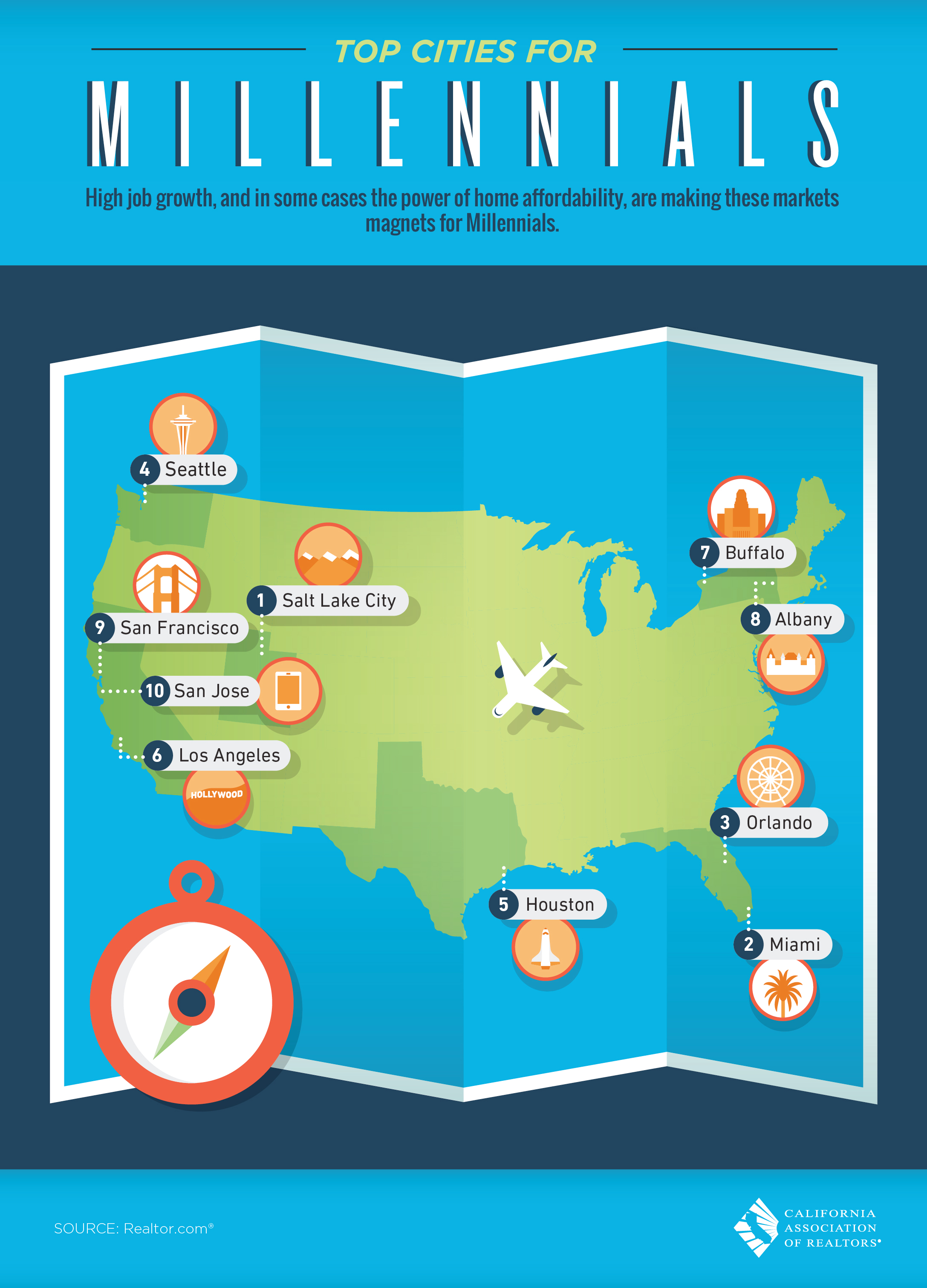
Top 10 Cities for Millennial Homebuyers
Based on affordability, job growth, millennial population density, and quality of life, these cities offer the best value:
1. Indianapolis, IN
Median Home Price: $250,000 | Millennial Population: 28%
Indianapolis offers an unbeatable combination of affordability and opportunity. Strong manufacturing, healthcare (Eli Lilly), and tech sectors provide diverse employment. The city's revitalized downtown features walkable neighborhoods, breweries, and a thriving food scene. Low cost of living means millennials can afford starter homes on single incomes—rare in today's market.
2. Pittsburgh, PA
Median Home Price: $220,000 | Millennial Population: 26%
Once a steel town, Pittsburgh has reinvented itself as a tech and healthcare hub. Google, Uber, and Carnegie Mellon attract young talent. Affordable Victorian homes in neighborhoods like Lawrenceville and Shadyside offer character and value. Strong public transit and walkability appeal to environmentally-conscious millennials.
3. Columbus, OH
Median Home Price: $280,000 | Millennial Population: 30%
Home to Ohio State University, Columbus has a massive millennial population and thriving job market. Intel's new $20 billion chip factory will create 10,000+ jobs. The Short North Arts District, German Village, and Clintonville neighborhoods offer urban amenities at Midwest prices. State capital means stable government jobs.
4. Raleigh-Durham, NC (Research Triangle)
Median Home Price: $380,000 | Millennial Population: 27%
The Research Triangle (Raleigh-Durham-Chapel Hill) combines tech jobs, university culture, and Southern affordability. Apple, Google, and hundreds of startups offer high-paying careers. Excellent schools, mild weather, and outdoor recreation (mountains and beaches both 2-3 hours away) make it ideal for families. Prices are rising but still reasonable compared to coastal cities.
5. Nashville, TN
Median Home Price: $420,000 | Millennial Population: 29%
Nashville's explosive growth reflects its appeal: thriving music scene, no state income tax, diverse job market (healthcare, music, tech), and Southern hospitality. The Gulch, East Nashville, and Germantown neighborhoods attract young professionals. Prices have risen significantly but remain cheaper than comparable markets like Austin ($550K median).
6. San Antonio, TX
Median Home Price: $310,000 | Millennial Population: 28%
San Antonio offers big-city amenities at small-city prices. No state income tax, military presence (multiple bases), healthcare (USAA, major hospitals), and tourism provide job stability. Mexican-American culture, authentic Tex-Mex, and the River Walk create vibrant lifestyle. Significantly cheaper than Austin (45 minutes north) while offering similar Texas benefits.
7. Salt Lake City, UT
Median Home Price: $450,000 | Millennial Population: 31%
Tech hub ("Silicon Slopes") with world-class outdoor recreation. Skiing, hiking, and mountain biking within 30 minutes of downtown. Strong job market (Adobe, Goldman Sachs, tech startups), family-friendly culture, and relatively affordable housing (compared to Denver: $575K or Seattle: $650K). Dry climate and clean air appeal to health-conscious buyers.
8. Tampa-St. Petersburg, FL
Median Home Price: $395,000 | Millennial Population: 25%
Florida's Gulf Coast offers beaches, no state income tax, and booming job market. Tech companies relocating from California, healthcare systems, and tourism provide diverse employment. Millennials flock to St. Pete's arts district and Tampa's Channelside. Weather appeals to remote workers who can live anywhere.
9. Boise, ID
Median Home Price: $480,000 | Millennial Population: 27%
Boise exploded during COVID as remote workers discovered affordable mountain living. Tech companies (Micron, HP), outdoor recreation, and small-city charm attract millennials escaping California/Seattle. Prices have surged but remain below West Coast alternatives. Growing pains include increased traffic and housing shortages.
10. Atlanta, GA
Median Home Price: $375,000 | Millennial Population: 29%
Major metro affordability—Atlanta offers big-city jobs (Delta, Coca-Cola, tech sector) at reasonable prices. Diverse neighborhoods (Virginia-Highland, Inman Park, Decatur) provide urban lifestyle. Major airport means easy travel. Growing film/entertainment industry ("Hollywood of the South") creates creative jobs. Traffic is rough but improving with transit expansion.
What Millennials Look For in a City
Millennials prioritize different factors than previous generations:
- Walkability & Public Transit: 60% prefer walkable neighborhoods with restaurants, coffee shops, and entertainment
- Outdoor Recreation: Proximity to hiking, biking, parks, and natural spaces ranks high
- Food & Culture: Diverse dining, breweries, arts scenes, and cultural events matter more than nightlife
- Remote Work Friendly: High-speed internet infrastructure and coworking spaces essential
- Affordability: Ability to buy starter homes ($250K-$400K) without sacrificing quality of life
- Job Diversity: Not dependent on single industry—diverse economic base provides stability
- Progressive Values: Environmental sustainability, diversity, and inclusive policies attract educated millennials
Affordability Strategies for Millennial Buyers
Even in affordable markets, buying your first home requires strategic planning:
Low Down Payment Options
- FHA Loans: 3.5% down, credit scores as low as 580
- Conventional 97: 3% down for first-time buyers
- VA Loans: 0% down for veterans and active military
- USDA Loans: 0% down in rural/suburban areas (covers many suburbs of major cities)
Down Payment Assistance
Most states offer DPA programs providing $5,000-$15,000 in grants or forgivable loans. Many millennials don't know these exist. We help clients identify and apply for every available program to minimize out-of-pocket costs.
Timing Your Purchase
Buy during off-peak seasons (November-February) when competition drops 30-40%. Sellers are more willing to negotiate on price and repairs. Avoid spring/summer when bidding wars are common.
Consider Starter Homes
Don't buy your "forever home" first. Purchase a modest starter home, build equity for 3-5 years, then upgrade. This strategy builds wealth faster than renting while saving for a dream home.
The Bottom Line: Homeownership Is Within Reach
The narrative that millennials can't afford homes is outdated. By targeting affordable markets with strong job growth, leveraging low-down-payment programs, and understanding what truly matters (walkability, culture, outdoor recreation over square footage), millennials are becoming homeowners in record numbers.
The key is choosing the right market. Avoid San Francisco ($1.3M median), New York ($850K), or Los Angeles ($900K). Instead, focus on cities like Indianapolis, Pittsburgh, Columbus, and Nashville where $250K-$400K buys quality homes in vibrant neighborhoods with career opportunities.
Ready to join the 38% of millennials buying homes? Start with pre-approval, research these markets, and work with lenders who understand millennial buyers and low-down-payment programs.